
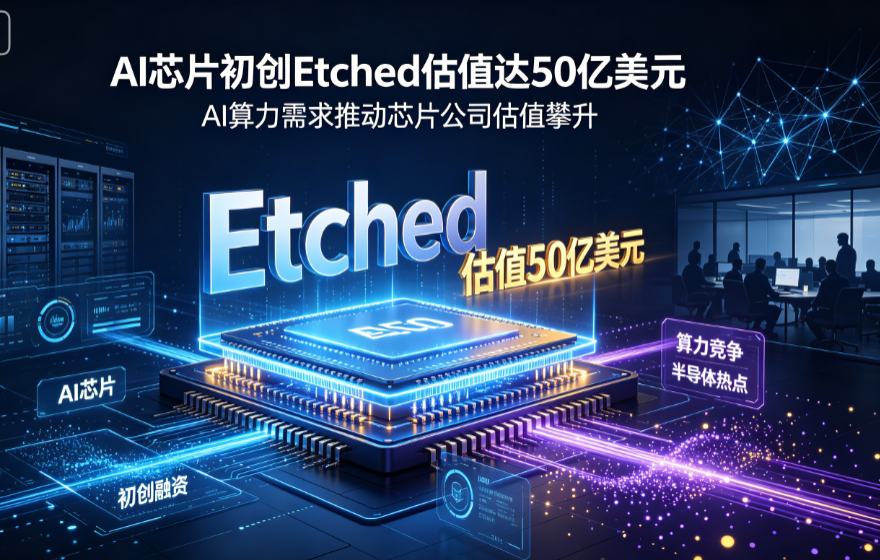
From Silicon Valley newcomer to the AI chip race: the technical logic and market showdown behind Etched's 5 billion dollar valuation
Keywords: AI chips; Etched; valuation; chip architecture; Transformer; compute bottleneck; venture capital
Introduction
In 2024, while the global semiconductor industry was still running on the inertia of "Moore's Law," an AI chip startup called Etched suddenly surged into public view. According to the latest news, Etched's latest financing round has pushed its valuation to 5 billion dollars, making it one of the most watched near-unicorns in the AI chip space and sparking deep debate over the future of dedicated AI chips. In a market that is almost dominated by Nvidia GPUs, why has capital become so excited about Etched? And can its technical route really rewrite the rules of the game? This article analyzes Etched's rise from three perspectives: technical architecture, market demand, and competitive landscape.
1. Technical uniqueness: the leap from general-purpose to purpose-built
Etched stands out among AI chip startups because of its extreme pursuit of specialization. Most AI chips—including Nvidia's GPUs and AMD's MI series—follow a general-purpose-computing logic, meaning one chip can handle image recognition, natural language processing, graphics rendering, and more. The trade-off is that many transistors inside the chip are used for control logic, cache, and interconnect rather than for a specific class of compute.
Etched took a completely different path. Its core chip is custom-optimized at the hardware level for one goal only: the Transformer architecture. Since Google introduced Transformer in 2017, that architecture has become the backbone of nearly every mainstream large language model, from GPT and Claude to LLaMA. Etched's chip hardwires key Transformer operations such as matrix multiplication and attention, eliminating all non-essential circuits. Reports say its inference efficiency on Transformer workloads can reach 5 to 10 times that of comparable GPUs, while power consumption is only about one-third as high.
This approach—designing a chip around one model architecture—looks aggressive, but it fits the deeper logic of the AI industry: once a model architecture becomes the de facto standard, the cost and efficiency advantage of a purpose-built chip can scale exponentially. Etched is betting that Transformer won't be fundamentally displaced anytime soon—at least not over the gold rush decade of large models, when it may be as unshakable as the x86 instruction set was in the PC era.
2. Market driver: exploding inference demand and the squeeze of compute bottlenecks
Etched's high valuation reflects the rapid expansion of the AI inference market. Over the past two years, the whole industry focused on training: whoever had more GPUs could train bigger models. But by 2024, a clear shift emerged—inference is replacing training as the biggest incremental source of compute demand. According to OpenAI estimates, each inference run of GPT-4 requires hundreds of times the compute of one parameter update during training. As ChatGPT-style applications have surpassed one billion users, inference-side compute consumption has already exceeded training-side demand.
At the same time, traditional GPUs are hitting obvious efficiency bottlenecks in inference scenarios. GPUs were originally designed to process large numbers of relatively simple graphics pixels in parallel. During AI inference, they need to repeatedly read weights from memory and execute attention calculations, and this "memory wall" means GPU utilization is often only 30%-50%. Etched's dedicated chip hardwires some model parameters into chip logic, greatly reducing dependence on high-bandwidth memory and achieving a read-once, compute-many-times effect.
In addition, the pressure of data-center energy consumption is speeding up adoption of specialized chips. Many countries and regions have already introduced data-center efficiency standards, and Etched's low-power design directly addresses that policy pain point. For large cloud vendors, if Etched can cut GPU inference costs by more than 70%, then even with higher initial deployment costs, the long-term economics may still work out very well.
3. Competition and risk: what are its odds?
Despite the eye-catching valuation, Etched's path is far from smooth. The competitive pressure it faces comes mainly from three directions.
First layer: Nvidia's "dimension reduction" strike. Nvidia has long recognized the threat from specialized chips, and its Blackwell architecture has already begun to incorporate targeted optimizations such as the Transformer Engine. More importantly, Nvidia has the full CUDA ecosystem, with millions of AI models written around CUDA. Etched's chip will need to re-adapt operator libraries and frameworks. For most enterprise users, the engineering cost of migrating to a new chip may exceed the performance gains the chip itself offers.
Second layer: other startups catching up. Companies following a similar route and already attracting strong market attention include Groq and Cerebras. Groq's LPU (Language Processing Unit) is also deeply optimized for Transformers and has already been deployed commercially in some use cases. Whether Etched can stay ahead in technical iteration speed and customer expansion remains uncertain.
Third layer: uncertainty in architectural evolution. Transformer itself is still evolving, with variants of the attention mechanism—such as RoPE and Flash Attention—appearing continuously, and even alternatives like state-space models such as Mamba. If a much more efficient architecture appears in the next two years, Etched's hardwired chip could face obsolescence. That is the biggest destiny of specialized chips.
4. Capital logic and industry lessons
Etched's ability to secure a 5 billion dollar valuation during a capital winter also reflects a shift in venture capital's strategy in AI infrastructure: capital is moving from "what to buy" to "what to build." In the first two waves of AI investment, VCs favored model and application layers such as OpenAI, Anthropic, and various AI SaaS companies. By 2024, investors realized that underlying compute is the true bottleneck for the entire industry. If specialized chips can be proven viable, their market size could far exceed any single model company.
Another aspect of Etched's high valuation is the clear flavor of an "option bet"—investors are betting the company can move from small-batch customization to mass production within three years. Chip manufacturing is a heavy-capex, long-cycle industry, and every step—TSMC capacity allocation, packaging yield, testing and validation—can become a life-or-death point. Whether Etched can tape out and deliver chips to customers in 2025 as planned is the key to whether the valuation can move from fantasy to reality.
Conclusion
Etched's 5 billion dollar valuation is both a "barometer" of the AI compute revolution and a test stone for the semiconductor industry's move toward specialization. Technically, the chip idea is correct and efficient; from a market perspective, the inference-demand window is clearly real; from a risk perspective, ecosystem barriers and architectural uncertainty cannot be ignored. For the industry as a whole, Etched's significance may not be whether it becomes "the next Nvidia," but that it proves one thing to the market: in this super-race of AI chips, the battle between general-purpose and specialized is far from over, and real innovation has always belonged to those willing to bet everything on a single direction and push it to the limit.
It is easy to foresee that 2025 will be a crucial year in the race to specialize AI chips. Whether Etched ultimately succeeds or becomes a footnote in history, it has already forced the entire industry to confront a fundamental question: when compute demand is growing exponentially, do we still need to rely on the kind of chip that is "good at everything but great at nothing"? The answer may already be written in Etched's circuit design.

