
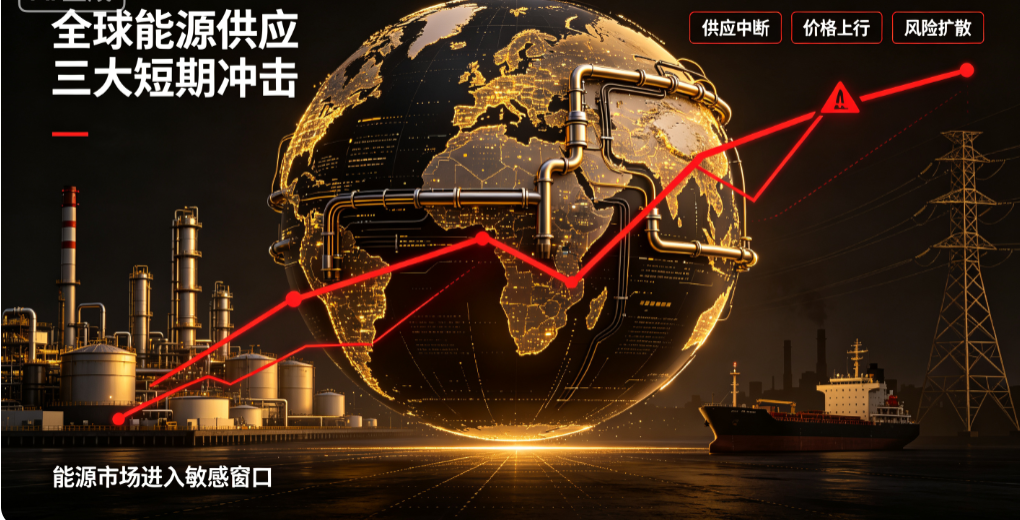
Global Energy Supply Dilemma: Three Short-Term Shocks Explained
Keywords: energy supply; short-term shocks; geopolitics; extreme weather; supply-demand imbalance
Introduction
In recent years, the global energy system has been undergoing unprecedented turbulence and challenges. After the sharp drop in demand brought on by the COVID-19 pandemic, energy demand around the world rebounded quickly, but supply failed to keep pace. At the same time, geopolitical conflicts, the increasing frequency of extreme weather, and structural contradictions in the energy transition together constitute the three major short-term shocks facing global energy supply today. These shocks have not only disrupted the stable operation of international energy markets, but have also profoundly affected the pace of economic recovery and the safeguarding of people’s livelihoods. Starting from these three dimensions, this article examines the specific manifestations and causes of short-term shocks, as well as their far-reaching impact on the global energy landscape, and explores ways to combine short-term responses with long-term transformation.
1. Geopolitical Conflicts: The “External Variable” of Energy Supply
Geopolitical risk has always been the most unpredictable “black swan” factor in international energy markets. Since 2022, the outbreak and continued escalation of the Russia-Ukraine conflict have dealt a severe blow to global energy supply chains. As one of the world’s major exporters of oil, natural gas, and coal, Russia has seen its energy exports severely constrained by multiple rounds of sanctions imposed by Western countries and by damage to its export infrastructure. European countries have been forced to sharply cut natural gas imports from Russia and turn to spot purchases of liquefied natural gas (LNG), sending global gas prices soaring and pushing up electricity and industrial production costs.
Geopolitical conflicts have not only directly reduced the actual supply of traditional energy, but have also amplified price volatility through market expectations. Governments and energy companies have activated strategic reserves and signed long-term contracts to avoid supply interruption risks, but in the short term they cannot fill the structural gap caused by sanctions and conflict. More complex still, geopolitical tensions in some regions are now extending from traditional fossil fuels into nuclear power, critical minerals, and other fields, further increasing uncertainty in global energy governance.
In the short term, supply contraction caused by geopolitical conflicts is characterized by sudden onset and uncertain duration. Once a conflict escalates or new sanctions take effect, energy prices may surge again, placing tremendous pressure on economies that are heavily dependent on imports. Therefore, the international community urgently needs a more resilient energy security mechanism, including stronger coordination of strategic reserves, broader supply channels, and deeper regional energy interconnection.
2. Extreme Weather: A Chain-Reaction Crisis in Energy Production and Transport in the Short Term
If geopolitical conflict is man-made, then extreme weather is both a natural disaster and a consequence of intensified human-driven climate change. In recent years, the frequency and intensity of extreme climate events worldwide—such as heatwaves, droughts, cold snaps, heavy snow, hurricanes, and floods—have increased significantly, severely disrupting energy production, transmission, and consumption.
Take Europe’s extreme heat and drought in 2022 as an example: water levels in important inland waterways such as the Rhine fell sharply, bringing inland transport of bulk energy materials such as coal and oil to a standstill; nuclear power in countries such as France and Spain was forced to reduce output because of insufficient cooling water; and hydropower generation dropped sharply, further intensifying electricity shortages. Meanwhile, Texas in the United States was hit by an extreme cold wave in early 2021, freezing natural gas pipelines, shutting down wind turbines, and leaving millions of households without power. These events show that the impact of extreme weather on energy systems runs through the entire chain: upstream resource extraction is hindered, midstream transport and storage face bottlenecks, and downstream demand surges exceed grid capacity.
In the short term, extreme weather often causes sudden regional energy supply disruptions or sharp contractions, and recovery can take a long time. Because weather conditions are difficult to forecast accurately, national energy systems lack sufficient redundancy to withstand such risks. Addressing this shock requires stronger climate resilience in energy infrastructure, including upgrading transmission networks to withstand extreme temperature swings, raising disaster-resilience standards for gas and oil storage facilities, and promoting distributed energy to reduce the risk of concentrated failures. At the same time, short-term emergency response mechanisms are also essential, such as cross-regional power mutual-aid agreements and platforms for extreme-weather alerts and supply-demand dispatch.
3. Supply-Demand Mismatch in the Energy Transition: Short-Term Structural Tensions
The energy transition is a long-term strategy for addressing climate change, but during the transition period it has produced a pronounced short-term supply-demand mismatch, becoming an important driver of current energy tightness. On the one hand, driven by carbon neutrality goals, countries are accelerating the phaseout of traditional fossil fuel capacity such as coal and fuel oil; on the other hand, although installed capacity for new energy sources such as wind and solar is expanding rapidly, their instability and intermittency remain prominent, and energy storage technology has not yet been deployed economically at scale. When the pace of retirement of traditional energy exceeds the pace at which new energy can effectively replace it, a short-term gap emerges.
Specifically, some European countries closed nuclear or coal-fired power capacity too early, leaving them without sufficient alternative baseload power when natural gas supplies tightened; the U.S. shale oil and gas industry slowed expansion under ESG (environmental, social, and governance) investment pressure, reducing its responsiveness to rising oil prices. In addition, the energy transition has triggered a surge in demand for critical minerals such as lithium, cobalt, and nickel, as well as rare metals, while their extraction and refining capacity cannot be rapidly increased in the short term. This keeps the cost of batteries and other storage components high, further limiting the balancing capacity of new energy systems.
In the short term, this supply-demand mismatch shows up as distorted price signals, hesitant investment decisions, and difficult inventory management. Energy companies face a double bind: shrinking traditional businesses and high uncertainty in emerging businesses. They are reluctant to expand fossil fuel capacity, yet they face technological bottlenecks and policy volatility in new energy. To break this deadlock, policymakers need to take a balanced approach: while accelerating the energy transition, retain a certain amount of flexible traditional energy capacity as a safety buffer; increase support for storage, hydrogen, carbon capture, and other foundational technologies; and improve carbon markets and green finance systems to provide stable incentives for the transition.
Conclusion
The three major short-term shocks facing global energy supply—geopolitical conflicts, the increasing frequency of extreme weather, and supply-demand mismatches in the energy transition—do not exist in isolation; they are intertwined and mutually reinforcing systemic problems. Geopolitical conflicts push up traditional energy prices and weaken countries’ ability to invest in the transition; extreme weather disrupts the stable operation of both new and traditional energy and worsens supply-demand imbalances; and the lack of coordination in the transition leaves markets with too little room to absorb sudden crises.
The combined effect of these short-term shocks shows that neither relying solely on market self-correction nor on a single energy policy is enough. Short-term responses should focus on improving the redundancy and resilience of energy systems, such as expanding strategic reserves, refining emergency dispatch mechanisms, and strengthening regional energy cooperation. In the medium to long term, it is necessary to firmly advance diversification of the energy mix and integration of climate resilience, achieving green development while safeguarding energy security. Only through multilateral cooperation under a global governance framework can we ease the pain caused by short-term shocks and lay the foundation for a sustainable, stable, and fair global energy system.

