
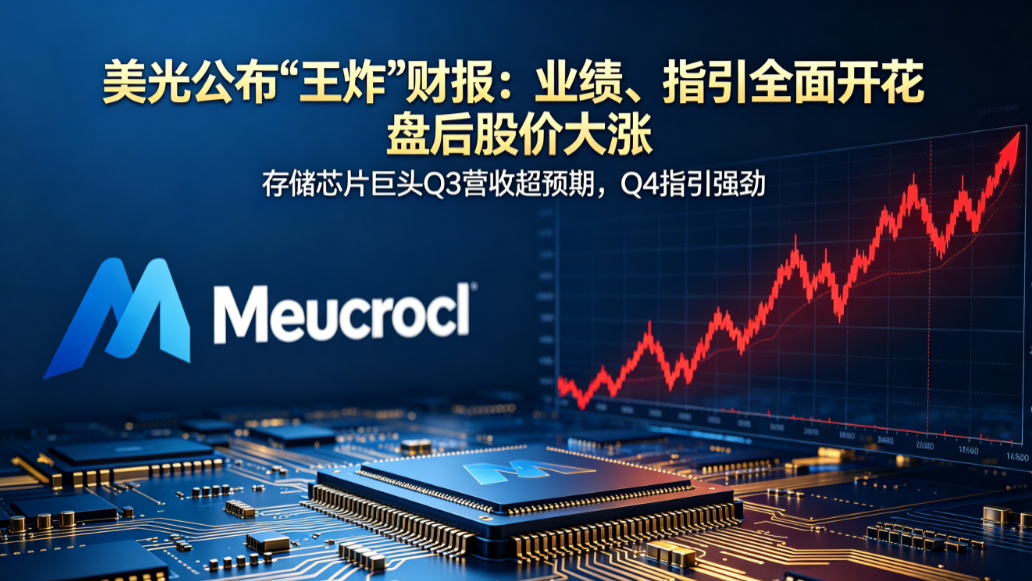
AI storage demand ignites results: Micron Technology's Q3 report points to the golden age of the memory-chip market
Introduction
After the close on Wednesday U.S. time, global AI storage leader Micron Technology released its fiscal third-quarter results for the period ending in May, delivering a jaw-dropping set of numbers: revenue surged 346% year over year, gross margin hit 84.9%, and net income made a dramatic reversal. The report not only blew past Wall Street expectations, but also sent the stock up more than 16% in after-hours trading and lifted the entire chip sector. With AI compute demand exploding, Micron is standing at the center of a new super cycle in memory chips.
Highlights: A "triple-crown" quarter that crushed expectations
Micron's financial performance this quarter was nearly flawless. Revenue reached 414.6 billion dollars, up 346% from 93 billion dollars a year earlier and far above the market expectation of 353 billion dollars. Adjusted EPS was 25.11 dollars, nearly 24% above the analyst consensus of 20.28 dollars. Gross margin came in at 84.9%, up 10 percentage points from 74.9% in the prior quarter and more than doubling from 39% a year ago. Together, these figures form Micron's "triple-crown" performance.
Even stronger, the guidance for the fourth fiscal quarter remained upbeat: revenue is projected to reach 500 billion dollars, well above the analyst estimate of 425 billion dollars; net income is forecast at 282.4 billion dollars and EPS at 24.46 dollars, compared with just 18.9 billion dollars and 1.68 dollars per share a year earlier. This continued outperformance shows Micron's dominant position in the AI storage dividend.
All four businesses moving in sync, with data centers as the growth engine
By segment, all four of Micron's businesses delivered strong growth, but the core data-center business was the standout. Sales in that division soared from 1.53 billion dollars a year ago to 11.5 billion dollars, an increase of more than 667%, confirming the strong demand for high-bandwidth memory (HBM) and enterprise SSDs from AI training and inference workloads.
Specifically, the company's data-center SSD revenue surpassed 5 billion dollars, while cloud storage memory revenue grew more than 300% to 13.77 billion dollars. Meanwhile, mobile and client business revenue rose more than 250% year over year to 11.52 billion dollars; and memory sales in automotive and embedded applications more than tripled to 4.63 billion dollars. This broad-based strength reflects the penetration of memory chips across the entire chain—from AI servers to smartphones, from autonomous driving to IoT endpoints.
Long-term agreements lock in the future, with 22 billion dollars of strategic commitments
Micron CEO Sanjay Mehrotra said on the earnings call that the company has signed 16 long-term agreements (LTAs) with data-center operators, automakers, and other customers to lock in sales for the next three to five years. These agreements are expected to bring 22 billion dollars in financial commitments, and all of them include binding purchase commitments for Micron chips.
Mehrotra stressed: "Once completed, we expect roughly half or more of company revenue to come from these strategic customer agreements." This long-term lock-in strategy not only gives Micron stable revenue visibility, but also confidence to scale capex. CFO Mark Murphy said: "We have clear visibility into market demand, and the commitment volumes give us the confidence to invest."
Supply shortages and capex expansion
Despite strong demand, supply shortages in memory chips will remain the main theme for years to come. Micron's CEO admitted: "Our customers already recognize that although we expect industry supply to improve gradually through 2028, memory shortages will still take a long time to ease." Against that backdrop, Micron plans to step up capital spending: fourth-quarter capex is expected to be about 10 billion dollars, full-year fiscal 2026 capex around 27 billion dollars, and fiscal 2027 quarterly capex will be even higher than fiscal 2026's fourth quarter.
At the same time, the company's next-generation technology roadmap is accelerating. Management said progress on next-gen DRAM and NAND nodes is strong and mass production is expected to begin in the second half of 2027. In particular, the ramp-up of HBM4 12-layer products is twice as fast as the current HBM3E 12-layer version, and the company has already delivered over 1 billion dollars of HBM4 revenue. This first-mover advantage will further cement Micron's leadership in the global AI storage market.
Shareholder returns and market confidence
Micron announced that shareholders will receive a 15-cent dividend per share in July, showing that the company values shareholder returns even while investing heavily in expansion. Over the past year, Micron's stock has risen about 700%, and its market cap has surpassed 1 trillion dollars. In after-hours trading, Micron's stock at one point rose more than 16%, while Western Digital climbed over 11%, Qualcomm rose over 10%, and Seagate jumped over 8%, reflecting the chip market's strong endorsement of the AI-driven growth thesis.
Conclusion: The golden age of AI storage has arrived
This earnings report is not just a success story for one company; it is a broad resonance across the AI industry, from compute to storage and from chips to systems. Behind the surge in demand for high-end AI chips such as Nvidia's and Google's custom processors, high-bandwidth memory and SSDs are being redefined by the market as the core components of the data "highway." As AI applications move from training to inference and from cloud to edge, memory demand is likely to follow a long-term trend of both volume and price rising together.
Micron's success comes from three engines working together: technological leadership (HBM4 and next-gen nodes), capacity lock-in (LTA agreements), and capital investment (massive expansion). For investors and industry watchers, the signal is crystal clear: the memory-chip market is undergoing a historic structural upgrade, and Micron is firmly in a favorable position. Over the next few years, storage companies that can keep investing, lock in customers, and lead on technology will reap the richest dividends of the AI era.

