
Analysis of the Federal Reserve's Possible Rate Hike or Rate Cut
Introduction
The Federal Reserve's interest-rate decisions are among the most closely watched policy signals in global financial markets. Every FOMC meeting does not just affect the dollar, Treasury yields, and U.S. equities; it also transmits through capital flows and trade channels to economies worldwide. Against the current backdrop of sticky inflation and slowing growth momentum, the key debate is whether the Fed will keep hiking to suppress prices or pivot to cuts to prevent a recession. This article analyzes that question from four dimensions: policy backdrop, decision factors, spillover effects, and outlook.
1. The Policy Logic Behind Hikes and Cuts
The Fed's monetary policy has two main goals: maximum employment and price stability, usually anchored by 2% core PCE inflation. Rate hikes typically occur when the economy is overheating and inflation is elevated. By raising the federal funds rate, the Fed lifts corporate borrowing costs and household credit burdens, dampening demand and cooling prices. Rate cuts, by contrast, usually come when growth slows, deflation risks rise, or financial stress increases, aiming to lower funding costs and stimulate investment and consumption.
Looking back at 2022-2023, the Fed used the most aggressive tightening pace in 40 years to fight historic inflation, raising the federal funds rate from near zero to the 5.25%-5.50% range. But in 2024, inflation in the U.S. has gradually eased while the labor market shows signs of cooling, and some indicators such as manufacturing PMIs and consumer confidence have weakened. As a result, market expectations have swung back and forth between peak hikes and looming cuts.
2. Decision-Making Under Current Economic Conditions
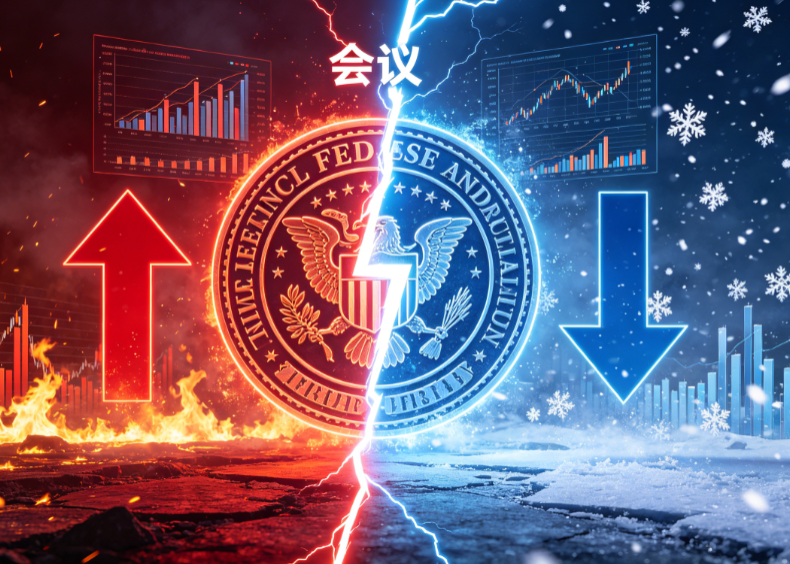
Before the most recent FOMC meeting, a range of data sent policymakers mixed signals. On one hand, core inflation remains above the 2% target, especially housing rents and services, which remain sticky. On the other hand, labor shortages have narrowed, unemployment has ticked up slightly, and retail sales have turned negative on a month-on-month basis. The chart below compares recent rate paths with market-implied expectations and clearly shows the complexity of the policy window.
In federal funds futures pricing, the market at one point expected two to three rate cuts in 2025, but hawkish comments from Fed officials pushed those expectations back. Chair Powell has repeatedly stressed a data-dependent and cautious approach, meaning the committee will not pivot abruptly based on any single month's numbers. In addition, geopolitical risks—such as tensions in the Middle East and global supply-chain disruptions—as well as the upward drift in long-term rates caused by expanding fiscal deficits, also constrain the room for cuts. If the Fed cuts too early and inflation rebounds, it faces both damage to credibility and the cost of tightening again later.
3. Spillover Effects on Financial Markets and the Global Economy
The Fed's rate decisions affect the world through multiple channels. First, because the dollar is the global reserve currency, hikes attract capital back to the United States, strengthen the dollar index, and can trigger emerging-market currency depreciation, capital outflows, and higher debt stress. For example, the Fed's aggressive hikes in 2022 triggered currency crises in some emerging economies. Second, Treasury yields are a benchmark for global asset pricing, so rate changes flow into sovereign bonds, corporate bonds, and equity valuations worldwide.
If the Fed pauses hikes or even cuts, that would help ease emerging-market capital outflows and give foreign central banks more room to ease policy. Conversely, if inflation proves stubborn and hikes resume, risk assets could face sharp repricing, especially high-valuation tech stocks and fragile emerging markets.
4. Outlook and Policy Advice
Looking ahead to the second half of 2025 and into 2026, the Fed will likely follow a gradual neutral path: keep rates unchanged or cut only modestly until inflation is clearly below 2% and labor-market deterioration becomes obvious. Market participants should focus on high-frequency data such as core PCE, nonfarm payrolls, and wage growth, while also watching for volatility driven by expectation gaps. For investors, lowering duration exposure and increasing defensive allocations may be an effective response to interest-rate divergence. For policymakers, international macro-policy coordination should be strengthened to prevent cross-border contagion from rate moves.
Conclusion
Fed rate hikes or cuts are never a simple linear choice; they are a balancing act under multiple objectives and constraints. Today's data are mixed, but overall they point to a rising chance of a soft landing, which means easing may come later than the market's optimistic expectations. Understanding the Fed's logic, staying patient, and adjusting expectations dynamically are the keys to navigating this data-dependent era. The wording of the next few statements and the dot plot will remain the market's core lens.

