2026 World Artificial Intelligence Conference Draws International Attention: China's Approach Injects New Momentum into Global Governance
Keywords: World Artificial Intelligence Conference, global AI governance, international cooperation, open-source AI, Global South, digital divide, technical standards, people-centered
Introduction
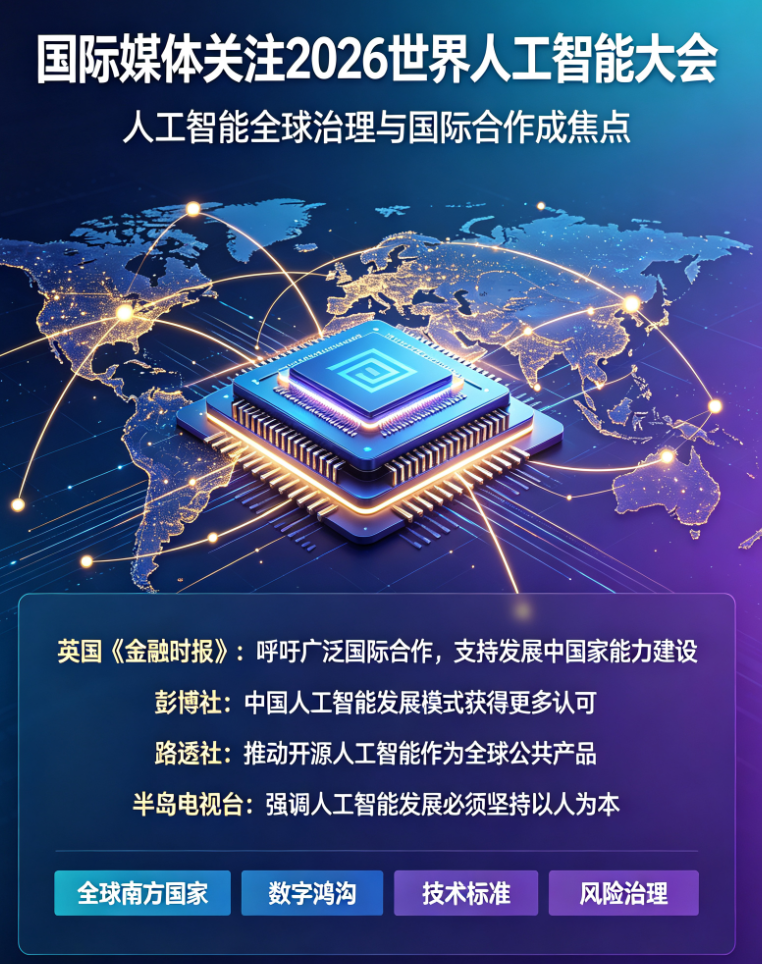
Recently, the 2026 World Artificial Intelligence Conference and High-Level Meeting on Global AI Governance held in Shanghai became a focal point for many international media outlets. The Financial Times, Bloomberg, Reuters, Al Jazeera and others published reports one after another, interpreting China's role and influence in global AI development from multiple dimensions such as international cooperation, technological openness, capacity building and governance concepts. Foreign media widely believe that this conference not only showcased the latest achievements of China's AI industry, but also sent a clear signal that China is willing to share technology, experience and opportunities with countries around the world, offering new ideas and a new platform for building a global AI governance system.
China Advocates Open Cooperation and Promotes Broad Global Participation
The Financial Times noted that China explicitly called for broad international cooperation on artificial intelligence at the conference and announced training support for developing countries to help them strengthen AI capacity building. This stance sends a clear signal: AI should not become an exclusive advantage for a handful of countries; it should become a development resource shared by all humanity.
Against the backdrop of intensifying global technology competition, AI is no longer merely a technical issue, but also a development issue, a governance issue and an international rules issue. China's proposal to advance joint consultation, joint construction and shared benefits is, in essence, an effort to enable countries to participate together in rule-making, technical exchanges and industrial collaboration on the basis of mutual respect and mutual benefit. For many developing countries, the foundations for AI applications are weak, talent reserves are insufficient and computing resources are limited. If they can obtain targeted training and support, it will help them quickly make up for their shortcomings and avoid being further marginalized in the new round of technological revolution.
The Financial Times especially mentioned that the establishment of the World Artificial Intelligence Cooperation Organization provides a new platform for countries to engage in AI technology cooperation and global governance. This means the international community's cooperation mechanisms in the field of AI are being further improved, moving from unilateral dominance to multilateral consultation, and from fragmented cooperation to institutionalized coordination.
China's Model Gains Broader Recognition, and Closing the "Intelligence Divide" Becomes a Consensus
Bloomberg's report focused on the international recognition of China's AI development model. It said China supports Global South countries in building AI capabilities, promotes narrowing the AI gap and the digital divide, and helps prevent technological progress from further widening development gaps between countries. For the vast number of developing countries, this concept has strong practical significance.
At present, global AI development is uneven. A few developed countries control core algorithms, computing platforms and data resources, while many developing countries still face problems such as weak infrastructure, insufficient application scenarios and a shortage of interdisciplinary talent. If this imbalance continues to widen, AI is likely to exacerbate the existing digital divide, thereby affecting fairness and inclusiveness in international development. By emphasizing capacity building and technological accessibility at the conference, China is in essence working to ensure that the dividends of AI benefit countries around the world more broadly, especially Global South countries with limited resources but urgent development needs.
This also shows that China's experience in AI development is no longer confined to domestic industrial upgrading, but has formed a practical model at the international level that can be referenced, exchanged and replicated. Whether in building an industrial ecosystem, expanding application scenarios, or providing policy support and talent training, China is proving through concrete action that technological progress does not necessarily mean monopoly and exclusion; it can also become a public resource that promotes common development.
Open Source and Sharing: Making AI a "Public Good for the World"
Reuters pointed out in its report that China is actively promoting open-source AI development and treating it as a public good for the world, sharing technology, experience and expertise with Global South countries. Open source means not only technological openness, but also knowledge sharing, ecosystem co-construction and innovation diffusion. For a field like AI, which depends heavily on collaborative innovation, the open-source model helps lower technical barriers and enables small and medium-sized enterprises, research institutions and developing countries to enter the application stage more quickly.
China's rapid progress in AI in recent years has been made possible by the continued coordination of its industrial, innovation and application chains. Now, as China further turns this development experience into a resource for international cooperation, its significance goes beyond a single technology export and instead helps shape a more balanced and more open global innovation landscape. Especially in livelihood-related areas such as healthcare, agriculture, education and urban governance, open-source AI can help more countries obtain technical support at lower cost, thereby unlocking broader social value.
Reuters also noted that as China's AI technology, industrial ecosystem and application capabilities continue to improve, China is playing an increasingly important leading role in global AI cooperation, technical standards and governance system building. This shows that China is not only an important participant in the global AI industry, but is also gradually becoming an important driver of global rules and order building.
Staying People-Centered to Set the Value Compass for AI Governance
Al Jazeera's report approached the issue from a governance perspective, emphasizing that Chinese officials pointed out at the opening ceremony that AI development must remain people-centered. The faster AI develops, the more it needs clear technological boundaries and ethical red lines. Technology itself is neither good nor bad; the key lies in how it is used, who controls it and whom it serves. Therefore, AI governance must pay attention not only to efficiency, but also to security, fairness, accountability and sustainability.
China proposed further improving laws and regulations in the AI field, strengthening technological monitoring, and enhancing risk early warning and emergency response mechanisms, reflecting a forward-looking judgment on technological risks. As generative AI, embodied intelligence and large-model applications continue to expand, issues such as data security, privacy protection, algorithmic bias, content credibility and system loss of control are all rising. Only by continuously improving the institutional framework can we ensure that AI development always advances in a direction that benefits human well-being.
From the perspective of international governance, "people-centered" is not only a value proposition, but also a governance principle. It requires the international community, when promoting technological innovation, to always place human safety, dignity and development first, and to avoid turning technology into a tool that intensifies conflict, amplifies inequality or triggers new risks. By emphasizing this concept at the conference, China also provided an important value reference for global AI governance.
Conclusion
Overall, the reason the 2026 World Artificial Intelligence Conference and High-Level Meeting on Global AI Governance drew wide international media attention lies not only in its presentation of the latest progress in China's AI development, but also in China's proposal of a global governance approach that combines openness, inclusiveness and practical feasibility. Whether it is promoting international cooperation, supporting capacity building in the Global South, or advocating open sharing and people-centered development, all of this reflects China's sense of responsibility in making AI a public good that benefits the world.
Today, as AI profoundly reshapes the global economy, society and governance structure, no country can solve all problems on its own. Only by strengthening dialogue, deepening cooperation and sharing achievements can AI better serve the common interests of humanity. The Shanghai conference released not only China's voice, but also a world solution for the future.